Roti sabzi calories: calculator and chart
Two rotis with a katori of sabzi come to about 280 kcal. Four rotis with sabzi are about 485 kcal, and a katori of dal adds about 145 more. Set your own plate below, rotis, dal, sabzi, rice, ghee and curd, and see the calories and protein add up as you go.
10 g protein
About 20% of a 1,400 kcal weight-loss day.
How many calories are in roti and sabzi?
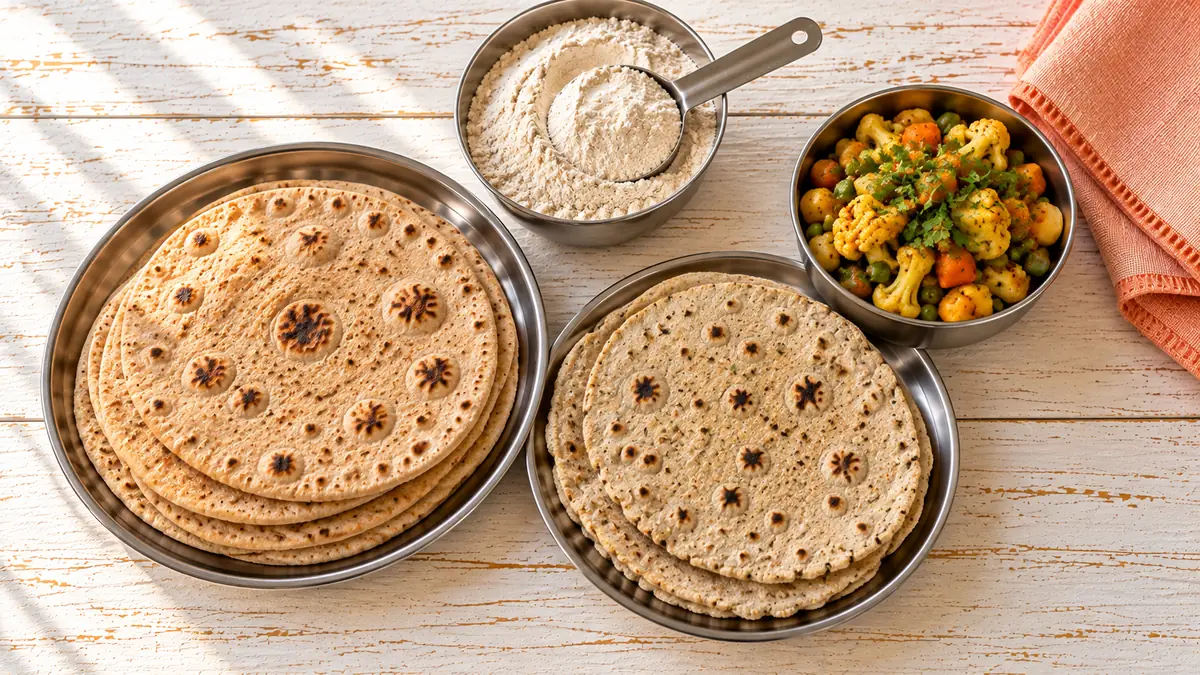
A medium roti made from 30 g of whole wheat atta has about 100 kcal and 4 g of protein. A katori of mixed sabzi cooked in one teaspoon of oil has about 80 kcal. So:
| Roti + 1 katori sabzi | No ghee | 1 tsp ghee on each roti | Protein |
|---|---|---|---|
| 1 roti + 1 katori sabzi | 180 kcal | 225 kcal | 6 g |
| 2 roti + 1 katori sabzi | 280 kcal | 370 kcal | 10 g |
| 3 roti + 1 katori sabzi | 385 kcal | 515 kcal | 14 g |
| 4 roti + 1 katori sabzi | 485 kcal | 665 kcal | 18 g |
| 5 roti + 1 katori sabzi | 590 kcal | 810 kcal | 22 g |
| 6 roti + 1 katori sabzi | 690 kcal | 955 kcal | 26 g |
Look at the ghee column. A teaspoon of ghee on each of four rotis adds about 175 kcal, more than a whole katori of sabzi and dal together. If you love ghee, put half a teaspoon on one roti instead of every roti.
How many calories are in roti and dal?
A katori of toor dal made from 30 g of dry dal is about 100 kcal, and a one-teaspoon tadka brings it to about 145 kcal with 7 g of protein. Moong and masoor dal are within 5 kcal of toor.
| Roti + 1 katori dal | Calories | Protein |
|---|---|---|
| 1 roti + 1 katori dal | 245 kcal | 11 g |
| 2 roti + 1 katori dal | 350 kcal | 15 g |
| 3 roti + 1 katori dal | 450 kcal | 18 g |
| 4 roti + 1 katori dal | 555 kcal | 22 g |
| 5 roti + 1 katori dal | 655 kcal | 26 g |
How many calories are in dal, chawal, roti and sabzi?
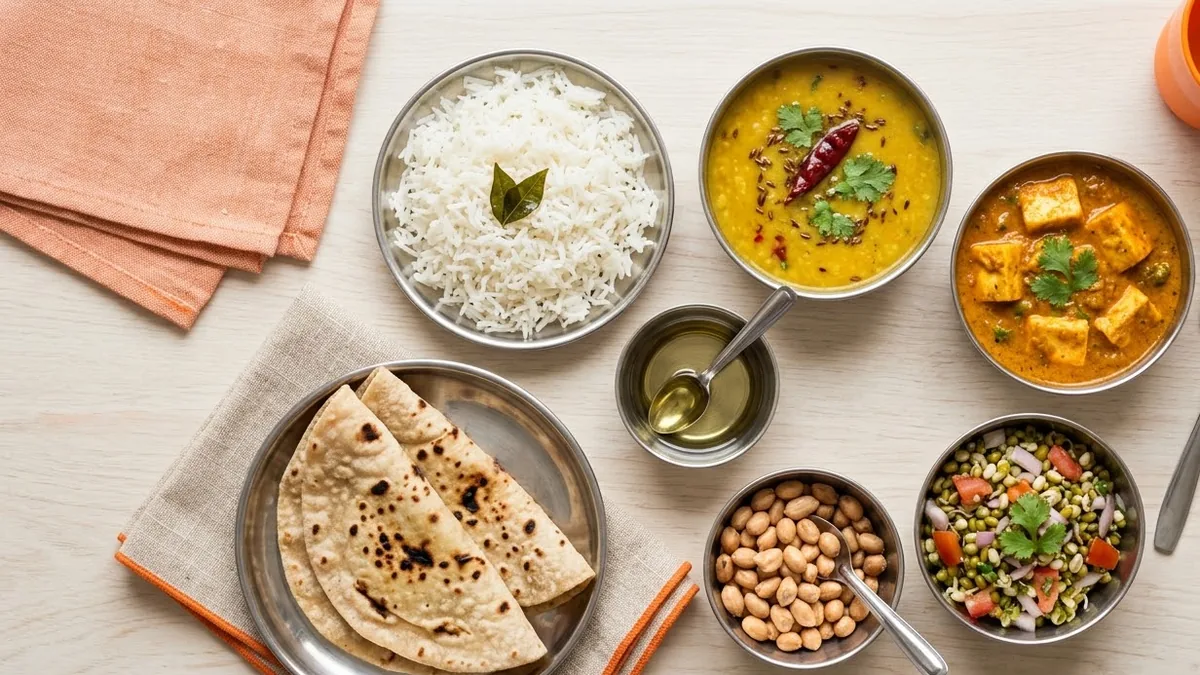
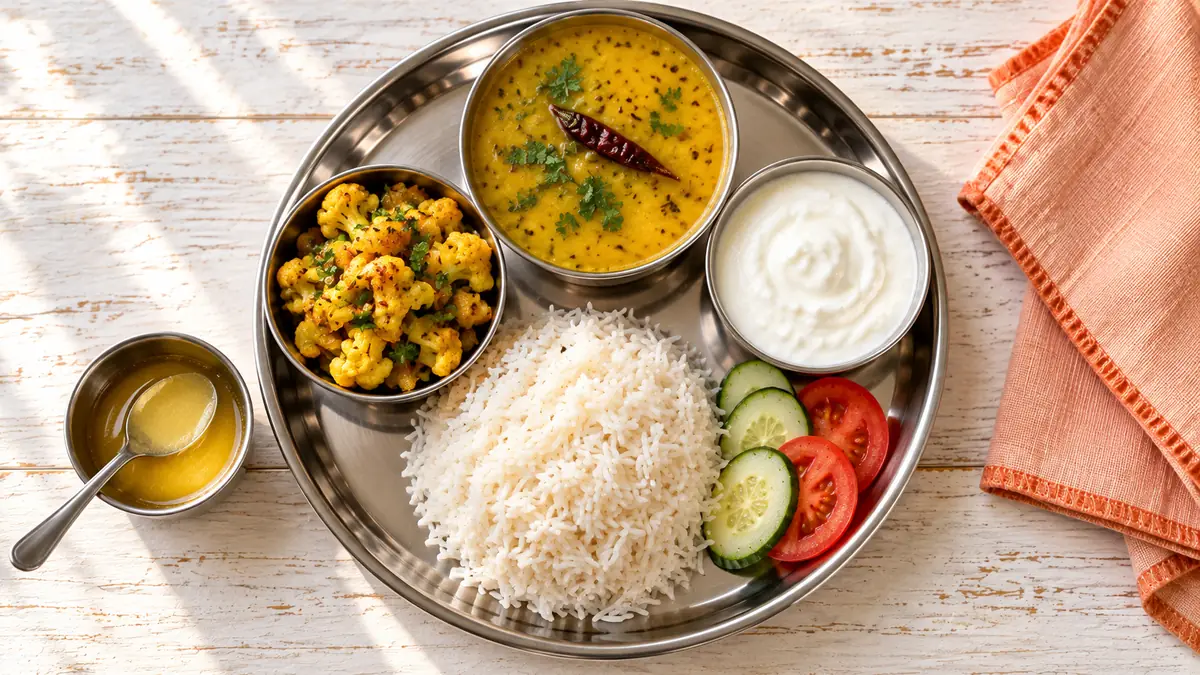
This is the everyday Indian thali: rotis with a katori each of dal and sabzi, and often a katori of rice. With one teaspoon of oil in the dal and one in the sabzi:
| Rotis | + dal + sabzi | + dal + sabzi + rice | Protein (with rice) |
|---|---|---|---|
| 1 roti | 325 kcal | 510 kcal | 16 g |
| 2 roti | 425 kcal | 610 kcal | 20 g |
| 3 roti | 530 kcal | 710 kcal | 24 g |
| 4 roti | 630 kcal | 815 kcal | 28 g |
| 5 roti | 735 kcal | 915 kcal | 32 g |
For most women trying to lose weight, a lunch of about 400 to 550 kcal works well, so two rotis with dal and sabzi, or one roti with dal, sabzi and rice, fits. A katori of curd and a plate of salad add protein and fullness for about 110 kcal more.
How many calories are in 1 katori of sabzi?
The vegetables themselves are light. A katori starts as about 120 g of chopped vegetables before cooking. What changes the number is the oil:
| 1 katori of | No oil | With 1 tsp oil | Protein |
|---|---|---|---|
| Lauki | 15 kcal | 60 kcal | 0.7 g |
| Tori | 25 kcal | 70 kcal | 1.4 g |
| Palak | 30 kcal | 70 kcal | 3.4 g |
| Gobi | 30 kcal | 75 kcal | 2.3 g |
| Baingan | 30 kcal | 75 kcal | 1.2 g |
| Mixed vegetable | 35 kcal | 80 kcal | 2.1 g |
| Beans | 35 kcal | 80 kcal | 2.2 g |
| Capsicum | 40 kcal | 85 kcal | 1.4 g |
| Bhindi | 40 kcal | 85 kcal | 2.3 g |
| Methi | 60 kcal | 105 kcal | 5.3 g |
When a katori of sabzi gets two or three teaspoons of oil, a 35 kcal katori becomes 125 to 165 kcal. Measuring one teaspoon into the kadhai, instead of pouring, is the easiest calorie cut in Indian cooking.
How many rotis should you eat to lose weight?
For most women, two rotis at lunch and one or two at dinner, with a full katori of dal or another protein and a big portion of sabzi, fits a weight-loss day of about 1,300 to 1,600 kcal. The exact number depends on your height, weight and how active you are. Our guide to roti and weight loss goes through it, and the BMI and calorie calculator works out your own daily number.
How are these calories worked out?
Every number comes from the Indian Food Composition Tables per 100 g, the same food data the BodyQuest app uses to plan meals. Atta, rice and dal are counted by their dry weight, because that does not change with how much water you cook them in. One roti is 30 g of atta, one katori of rice is 50 g of raw rice, and one katori of dal is 30 g of dry dal (40 g for rajma and chole). Oil and ghee are both about 45 kcal a teaspoon. For a longer list of foods, see the calories in Indian food chart.
Questions people ask
How many calories are in 2 roti and 1 katori sabzi?
About 280 kcal and 10 g of protein: two rotis of 30 g atta each (about 100 kcal each) and a katori of mixed sabzi cooked in one teaspoon of oil (about 80 kcal).
How many calories are in 4 roti and 1 katori sabzi?
About 485 kcal and 18 g of protein, without ghee. With a teaspoon of ghee on each roti it is about 665 kcal.
How many calories are in 5 roti with ghee and sabzi?
About 810 kcal with a teaspoon of ghee on each of the five rotis and a katori of sabzi, or about 590 kcal with no ghee on the rotis.
How many calories are in 4 roti and 1 katori dal?
About 555 kcal and 22 g of protein: four rotis (about 410 kcal) and a katori of toor dal with a one-teaspoon tadka (about 145 kcal).
How many calories are in dal, chawal, roti and sabzi?
Two rotis, a katori each of dal, sabzi and rice come to about 610 kcal and 20 g of protein, with one teaspoon of oil in the dal and one in the sabzi.
How many calories are in 1 katori sabzi?
Between about 15 and 60 kcal for the vegetables alone, depending on the sabzi: lauki is the lightest and methi the highest. The oil adds about 45 kcal for every teaspoon, so a home-style katori is usually 60 to 100 kcal.
Sources
- ICMR-NIN: Indian Food Composition Tables (2017)
- ICMR-NIN: Dietary Guidelines for Indians (2024)
- NHS: Understanding calories

BodyQuest is a home weight-loss programme for Indian women, made by ASANAR STUDIOS in Mohali, Punjab. The calories, protein and portions in our articles come from the same food data and method the BodyQuest app uses to build each member's daily plan, and our advice follows the public guidance listed under Sources. We are not doctors: for a health condition, check with yours.
BodyQuest gives general fitness and food guidance for healthy adults. It does not diagnose or treat any condition. If you are pregnant, breastfeeding, or managing a health condition such as diabetes, thyroid or PCOS, check with your doctor before changing your diet or exercise.